News
Madrid: Rail Leaders’ Dialogue on Rail Baltica, Dual-Gauge Infrastructure and Economic Value

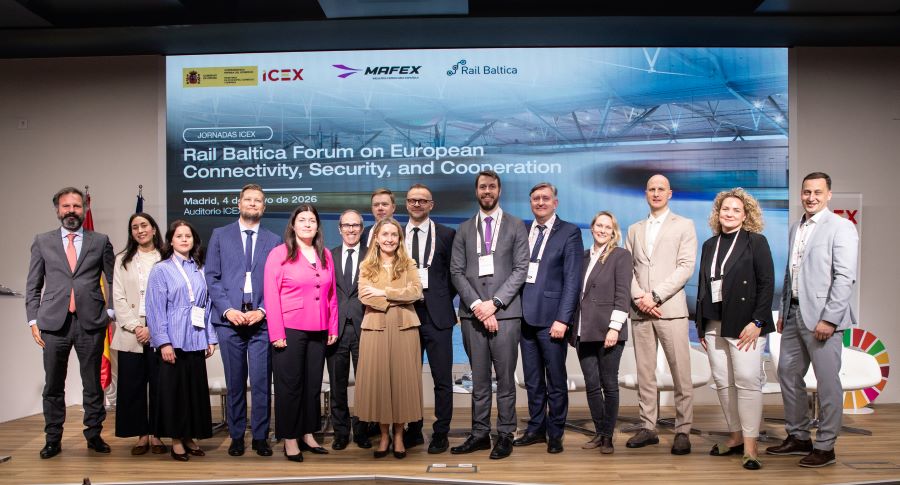
In Madrid, a high-level forum of European railway and transport sector leaders took place, focusing on the strategic Rail Baltica project, the development of dual-gauge railway infrastructure, and economic opportunities across Europe. Discussions addressed the outlook of Rail Baltica and included exchanges with the Spanish railway infrastructure manager, rail operators, defence industry representatives and the business community.
“International cooperation with partners in Spain and other countries is one of the key prerequisites for delivering a transport project of this scale as Rail Baltica. By building European standard gauge railway infrastructure, we are investing not only in more efficient passenger and freight mobility, but also in Europe’s overall security and resilience,” says Roderikas Žiobakas, Vice-Minister of Transport and Communications of Lithuania.
Vytautas Radzevičius, LTG Group Director for Strategy and Business Development and co-acting CEO, emphasises that Rail Baltica is not only a Baltic infrastructure development initiative, but also a significant opportunity for European industry and business.
“A wide range of European partners are contributing to the Rail Baltica project in Lithuania – from design and engineering to the production of materials. The involvement of Spanish companies already demonstrates that the project creates mutual value. Therefore, as a new EU funding period approaches, it is important to underline that investments in the Baltic region generate tangible returns for Europe as a whole,” says Radzevičius.
Spain’s interest in the Baltic region
Óscar Puente Santiago, Spain’s Minister of Transport and Sustainable Mobility sent a clear message of support for Rail Baltica as a flagship European project. “Rail Baltica is a project that gives meaning to the very concept of European integration. It encapsulates and embodies the desire and the need for a more closely united European Union, with rail as the binding thread,” says Santiago.
Spain’s railway infrastructure comprises two-gauge standards: the 1,668 mm Iberian gauge and the 1,435 mm European standard gauge. The infrastructure manager also applies variable gauge systems, enabling seamless operations between the two without stopping.
Discussions involving leaders from the Spanish and Lithuanian transport sectors, representatives of LTG Group and RB Rail AS, as well as stakeholders from Latvia and Estonia, Baltic embassies in Spain, and the business community, focused strongly on solutions for integrating different rail gauges and mixed-use railway systems. Spain, one of Europe’s leaders in high-speed rail, shared its experience in effectively aligning diverse technical standards.
Next step: international passenger mobility
In Madrid, Kristina Meidė, CEO of LTG Group’s passenger transport company LTG Link, participated in bilateral business meetings with sector partners, focusing primarily on the development of international passenger mobility in response to growing travel flows.
“Our priority is to ensure smooth, fast and reliable international journeys for passengers. Spain’s experience in organising high-speed rail services across different regions and national borders is highly relevant as we further develop international services and prepare for the opportunities opened by Rail Baltica,” says Meidė.
High-level meetings such as this form part of Rail Baltica’s consistent communication of project progress across Europe, aimed at securing political and financial support in the upcoming 2028–2034 EU Multiannual Financial Framework, alongside other major European TEN‑T transport corridor projects.
Rail Baltica is a strategic project for both the LTG Group and the European Union and is the largest railway infrastructure project in the history of the Baltic States. Once completed, it will deliver an electrified European standard gauge railway line connecting Lithuania, Latvia, and Estonia with Central and Western Europe, strengthening regional integration, civil and military mobility, and the overall resilience of the transport system.
BackNext