News
2026-09-02
When technology falls short, human expertise steps in: an insight into one of the oldest railway professions
Lithuania’s railway infrastructure is rapidly modernising – with advanced technologies taking over an increasing number of traffic control functions. However, at some stations, safe train operations still begin with human intervention. Here, points are still switched manually, a task carried out by 50 pointsmen – representatives of one of the oldest railway professions.
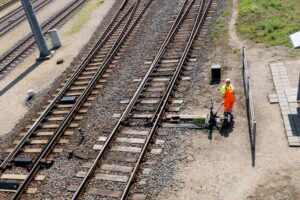
At present, at eight railway stations, pointsmen remain an integral part of safe train operations. They switch the points by hand, check their position, ensure that the tracks are clear, and, together with the station dispatcher, ensure that every train departs the station safely.
Passengers hardly notice them. Yet behind every safely prepared route lie human decisions, experience and responsibility.
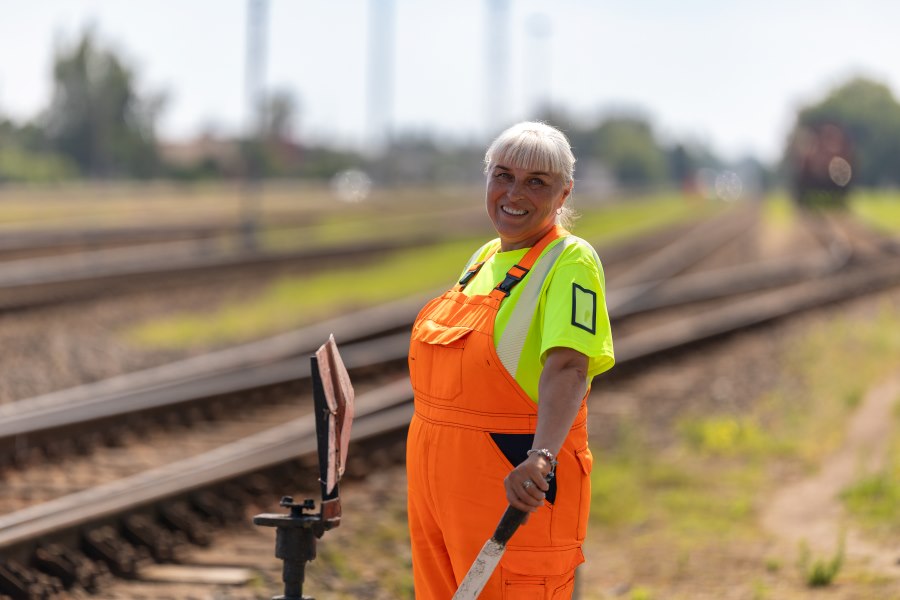
One such person is Svetlana Stanionienė, a pointsman at Marijampolė station. She has been working on the railways for almost two decades and says that, despite technological advances, the human role on the railways will remain important for a long time to come.
– What led you to work on the railways?
My husband led me to the railways – he’s also been a railway worker for many years. I’ve been working as a signalman since 2007. I started in Vilkaviškis, and later, when centralised traffic control was introduced there, I moved to work in Marijampolė.
Now there are three of us in the family working on the railways – my daughter works here too.
– Could you explain in simple terms what a pointsman does on a daily basis?
Our job is to manually set the train’s route. We switch the points and direct the train onto the required track – from the main line to a side track, or vice versa.
People often don’t even know what a points switch is. Yet the track the train takes depends on its position.
– How much responsibility does this job entail?
A great deal.
If the route were set up incorrectly or a points switch were left in the wrong position, the consequences could be very serious.
That’s why every action is carried out strictly in accordance with established procedures. We coordinate everything with the station dispatcher and check every step more than once.
You feel that responsibility throughout your entire shift.
– What is it like to work on the points?
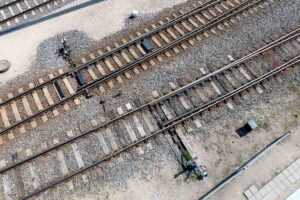
We operate nine sets of points at our station.
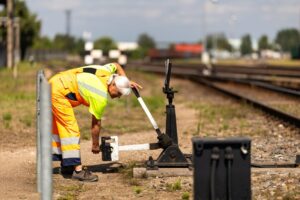
Manual points have a special lock. To switch them, you first need to take the key from the locking system, unlock the lock and only then physically move the mechanism to the other position.
Only after completing all these procedures can the station dispatcher lock the route and authorise the train to proceed.
The whole system is designed to minimise the possibility of error.
– Why must the keys always be in your hands?
These are strictly accounted-for keys.
From day one, we were taught not to keep them in our pockets – only in our hands. If a key were to go missing, it would be a very serious incident.
At the end of the shift, all the keys are returned to a special locking cupboard.
Such details may seem trivial from the outside, but on the railway, it is precisely these that ensure safety.
– What’s the hardest day at work?
It’s hardest when it’s snowing heavily.
Then we not only have to set the route, but also constantly clear the points so that the snow doesn’t prevent them from operating properly.
We work outdoors in all weathers – in the rain, freezing cold, blizzards and at night.
The railway doesn’t stop just because the weather outside is bad.
– What are the most challenging situations at work?
Technical faults are usually the source of difficulties.
If a gate or lock isn’t working as it should, we immediately inform the station dispatcher. Mechanics are then called in to rectify the fault.
The most important thing in such situations is to spot the problem as quickly as possible and pass on the information in good time.
– Is it difficult to become a pointsman? Are young people interested in this profession?
No specialised education is required, but training is essential, particularly regarding safety.
You have to learn a lot at the start, and later on, it’s all down to practice. After many years on the job, you know the routes, the keys and the procedures inside out – it all becomes second nature.
A new employee starts working alongside an experienced colleague, observes, learns and gradually takes on responsibility.
Are young people interested? I’d say not really.
It’s shift work, it requires a great deal of responsibility, and besides, everyone realises that the railways are modernising and such jobs are gradually becoming fewer.
Nevertheless, for the time being, we still need people.
– Will technology completely replace signalmen?
Automation is an ongoing process, and technology has already taken over many functions. That’s only natural.
However, machinery breaks down too.
When the system breaks down, you need someone who understands the whole process and knows what to do. I believe that computers alone are not enough – people will remain a vital link in the railway for a long time to come.
Sooner or later, modernisation will reach the remaining stations too. However, as long as there is even one station where points are still operated manually, the profession of the pointsman will remain a living part of Lithuania's railway system. At the same time, it serves as a reminder that even the most advanced technology cannot replace human responsibility and experience.
BackNext